Monday, June 22, 2015

Pile Testing

It is advisable to test load at least one pile per scheme. The test pile should be overloaded by at least 50% of its working load and this load should be held for 24 hours. The test pile should not form part of the actual foundations. Suitable testing methods are:

1 . Jacking against kentledge placed over test pile.
2. Jacking against a beam fixed to anchor piles driven in on two sides of the test pile.


Saturday, June 20, 2015

Pile Caps

Piles can be used singly to support the load but often it is more economical to use piles in groups or clusters linked together with a reinforced concrete cap. The pile caps can also be linked together with reinforced concrete ground beams. The usual minimum spacing for piles is:

1 . Friction Piles † 1„100 or not less than 3 x pile diameter, whichever is the greater.

2. Bearing Piles † 750 mm or not less than 2 x pile diameter, whichever is the greater.

Cast In-situ Piles

An alternative to the driven in-situ piles.

Cast In-situ Piles

Wednesday, June 17, 2015

Driven In-situ Piles

Used on medium to large contracts as an alternative to preformed piles particularly where final length of pile is a variable to be determined on site.

Driven In-situ Piles

Steel Tube Piles

Used on small to medium size contracts for marine structures and foundations in soft subsoils over a suitable bearing strata. Tube piles are usually bottom driven with an internal drop hammer. The loading can be carried by the tube alone but it is usual to fill the tube with mass concrete to form a composite pile. Reinforcement, except for pile cap bonding bars, is not normally required.

Steel Tube Piles

Tuesday, June 16, 2015

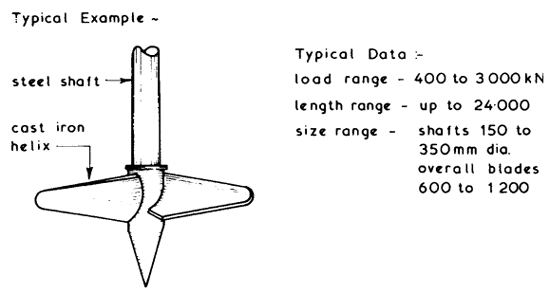
Steel Screw Piles

Rotary driven and used for dock and jetty works where support at shallow depths in soft silts and sands is required.

Steel Screw Piles

Friday, May 8, 2015

Steel Box and `H' Sections

Standard steel sheet pile sections can be used to form box section piles whereas the 'H' section piles are cut from standard rolled sections. These piles are percussion driven and are used mainly in connection with marine structures.