Showing posts with label FOUNDATIONS. Show all posts

Monday, April 11, 2016

Control of Ground Water

This can take one of two forms which are usually referred to as temporary and permanent exclusion.


Permanent Exclusion: this can be defined as the insertion of an impermeable barrier to stop the flow of water within the ground.

Temporary Exclusion: this can be defined as the lowering of the water table and within the economic depth range of 1500 can be achieved by subsoil drainage methods, for deeper treatment a pump or pumps are usually involved
.
Simple Sump Pumping: suitable for trench work and/or where small volumes of water are involved.
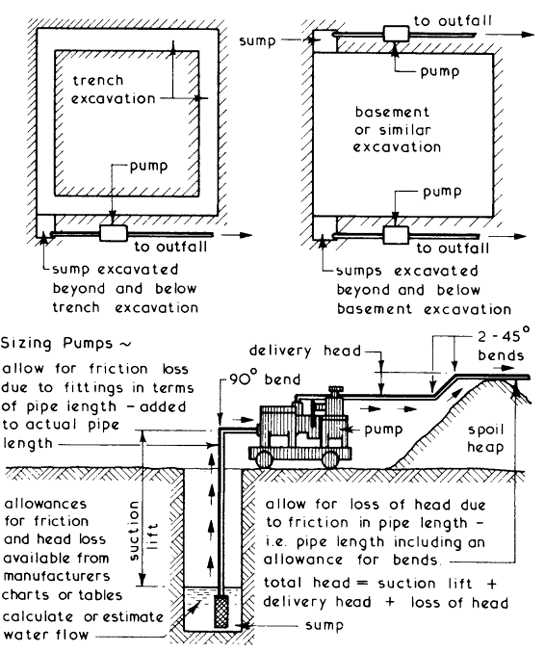
Problems of Water in the Subsoil

1. A high water table could cause flooding during wet periods.

2. Subsoil water can cause problems during excavation works by its natural tendency to flow into the voids created by the excavation activities.

3. It can cause an unacceptable humidity level around finished buildings and structures.

Underpinning Columns

Columns can be underpinned in the some manner as walls using traditional or jack pile methods after the columns have been relieved of their loadings. The beam loads can usually be transferred from the columns by means of dead shores and the actual load of the column can be transferred by means of a pair of beams acting against a collar attached to the base of the column shaft.

Underpinning Columns

Root Pile or Angle Piling

This is a much simpler alternative to traditional underpinning techniques, applying modern concrete drilling equipment to achieve cost benefits through time saving. The process is also considerably less disruptive, as large volumes of excavation are avoided. Where sound bearing strata can be located within a few metres of the surface, wall stability is achieved through lined reinforced concrete piles installed in pairs, at opposing angles. The existing floor, wall and foundation are predrilled with air flushed percussion auger, giving access for a steel lining to be driven through the low grade/clay subsoil until it impacts with firm strata. The lining is cut to terminate at the underside of the foundation and the void steel reinforced prior to concreting.

Root Pile or Angle Piling

In many situations it is impractical to apply angle piling to both sides of a wall. Subject to subsoil conditions being adequate, it may be acceptable to apply remedial treatment from one side only. The piles will need to be relatively close spaced.

Thursday, November 26, 2015

Pneumatic Caissons

These are sometimes called compressed air caissons and are similar in concept to open caissons. They can be used in difficult subsoil conditions below water level and have a pressurised lower working chamber to provide a safe dry working area. Pneumatic caissons can be made of concrete whereby they sink under their own weight or they can be constructed from steel with hollow walls which can be filled with water to act as ballast. These caissons are usually designed to form part of the finished structure.

Typical Caissons Details

These are box-like structures which are similar in concept to cofferdams but they usually form an integral part of the finished structure. They can be economically constructed and installed in water or soil where the depth exceeds 18000 There are 4 basic types of caisson namely:

Monday, June 22, 2015

Pile Testing

It is advisable to test load at least one pile per scheme. The test pile should be overloaded by at least 50% of its working load and this load should be held for 24 hours. The test pile should not form part of the actual foundations. Suitable testing methods are:

1 . Jacking against kentledge placed over test pile.
2. Jacking against a beam fixed to anchor piles driven in on two sides of the test pile.


Saturday, June 20, 2015

Pile Caps

Piles can be used singly to support the load but often it is more economical to use piles in groups or clusters linked together with a reinforced concrete cap. The pile caps can also be linked together with reinforced concrete ground beams. The usual minimum spacing for piles is:

1 . Friction Piles † 1„100 or not less than 3 x pile diameter, whichever is the greater.

2. Bearing Piles † 750 mm or not less than 2 x pile diameter, whichever is the greater.

Cast In-situ Piles

An alternative to the driven in-situ piles.

Cast In-situ Piles

Wednesday, June 17, 2015

Driven In-situ Piles

Used on medium to large contracts as an alternative to preformed piles particularly where final length of pile is a variable to be determined on site.

Driven In-situ Piles

Steel Tube Piles

Used on small to medium size contracts for marine structures and foundations in soft subsoils over a suitable bearing strata. Tube piles are usually bottom driven with an internal drop hammer. The loading can be carried by the tube alone but it is usual to fill the tube with mass concrete to form a composite pile. Reinforcement, except for pile cap bonding bars, is not normally required.

Steel Tube Piles

Tuesday, June 16, 2015

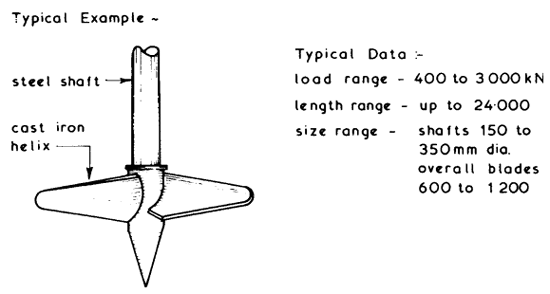
Steel Screw Piles

Rotary driven and used for dock and jetty works where support at shallow depths in soft silts and sands is required.

Steel Screw Piles

Thursday, April 23, 2015

Preformed Concrete Piles

Jointing with a peripheral steel splicing collar as shown on the preceding page is adequate for most concentrically or directly loaded situations. Where very long piles are to be used and/or high stresses due to compression, tension and bending from the superstructure or the ground conditions are anticipated, the 4 or 8 lock pile joint [AARSLEFF PILING] may be considered.

Preformed Concrete Piles

Preformed Concrete Piles

Variety of types available which are generally used on medium to large contracts of not less than one hundred piles where soft soil deposits overlie a firmer strata. These piles are percussion driven using a drop or single acting hammer.

Preformed Concrete Piles

Monday, March 16, 2015

Timber Piles

These are usually square sawn and can be used for small contracts on sites with shallow alluvial deposits overlying a suitable bearing strata (e.g. river banks and estuaries.) Timber piles are percussion driven.

Timber Piles

Displacement Piles

These are often called driven piles since they are usually driven into the ground displacing the earth around the pile shaft. These piles can be either preformed or partially preformed if they are not cast in-situ and are available in a wide variety of types and materials. The pile or forming tube is driven into the required position to a predetermined depth or to the required `set' which is a measure of the subsoils resistance to the penetration of the pile and hence its bearing capacity by noting the amount of penetration obtained by a fixed number of hammer blows.

Displacement Piles Types

Monday, March 2, 2015

Grout Injection Piling

A variation of continuous flight auger bored piling that uses an open ended hollow core to the flight. After boring to the required depth, high slump concrete is pumped through the hollow stem as the auger is retracted. Spoil is displaced at the surface and removed manually. In most applications there is no need to line the boreholes, as the subsoil has little time to be disturbed. A preformed reinforcement cage is pushed into the wet concrete.

Grout Injection Piling

Thursday, February 26, 2015

Replacement Piles

These are often called bored piles since the removal of the spoil to form the hole for the pile is always carried out by a boring technique. They are used primarily in cohesive subsoils for the formation of friction piles and when forming pile foundations close to existing buildings where the allowable amount of noise and/or vibration is limited.
Replacement Piles Types
Percussion Bored Piles
Flush Bored Piles
Small Diameter Rotary Bored Piles
Large Diameter Rotary Bored Piles

Thursday, February 12, 2015

Piled Foundations - Classification

These can be defined as a series of columns constructed or inserted into the ground to transmit the load(s) of a structure to a lower level of subsoil. Piled foundations can be used when suitable foundation conditions are not present at or near ground level making the use of deep traditional foundations uneconomic. The lack of suitable foundation conditions may be caused by:

1. Natural low bearing capacity of subsoil.
2. High water table - giving rise to high permanent dewatering costs.
3. Presence of layers of highly compressible subsoils such as peat and recently placed filling materials which have not sufficiently consolidated.
4. Subsoils which may be subject to moisture movement or plastic failure.

Classification of Piles, piles may be classified by their basic design function or by their method of construction:
Piled Foundations - Classification

Friday, February 6, 2015

Cantilever Foundations

These can be used where it is necessary to avoid imposing any pressure on an adjacent foundation or underground service.

Cantilever Foundations